Wednesday, November 01, 2006


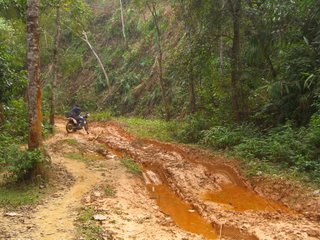
Support wall along the Ho Chi Minh highway in Northern Vietnam.
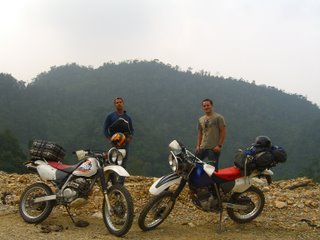
We found the only place in Vietnam (according to the owner) that rents large dirtbikes. For $22/day you can rent a Honda 250 XR and be the king of the road. We rented 2 bikes and became instant celebrities with the locals.

We took a 3 day trip through Northern Vietnam from Hanoi to Mai Chao and back on a loop. We definitely got off the beaten path on roads you won't find in the guide book. We encountered spectacular scenery, shitty roads, and a lot of curious looks. Upon arrival we generally attracted quite a crowd.

Everybody drives a motorbike in this country (very few personal cars), however, they all drive bikes that are 150 cc's or less. You can't buy anything bigger so you can imagine the reaction when some foreigners roll into town on something most Vietnamese people have never seen in person.


More fun with a monkey at a Bia Hoi establishment in Hanoi.

I am pretty sure that the Thai word for beer translates to "terpentine". It is expensive (compared to other costs here) and good beer in Thailand does not exist. Singha is shit, Leo is ok, and Heineken brewed in Bangkok is tolerable but exensive. Thai whiskey is awful and liquors are expensive so basically you are stuck drinking Singha or Leo. Wine is taxed heavily and much more expensive than it is back home. Basically, Thailand is not a beer lover's paradise... rather it is hell.

Cambodia was worse with Angkor beer being a mix between Singha and the curb water in Phnom Penh.

I didn't expect much different in Vietnam, however, I'm happy to say I was wrong. Bia Hoi is the world's cheapest beer. It is about 2,000 dong or 12 cents a glass and is available everywhere. It is "fresh beer" and has no preservatives as it is ready for drinking right away. It is generally served street side in the cities and the taste varies greatly. I found one I really like and have been back a few times in Hanoi. Finally a beer that fits the other prices in this part of the world and it actually tastes great.

A good Bia Hoi is accompanied by some squid jerky. (pictured above) This street vendor walks around with a basket of dried and flattened squid and a bucket of coals. She said it went great with beer so we ordered some. She grilled it on the coals and ripped it up into strips and served it with chili sauce. It was good.

This was our room at the Spirit House in Hanoi, Vietnam... the room sucked but we talked them down from $25 to $14 so we took it.


We visited the War Remnants Museum (formerly known as the "Museum of Chinese and American War Crimes") in Ho Chi Minh City, Saigon. It is incredible how warm and welcoming the Vietnamese people are to Americans considering the devastation the US caused the Vietnamese people. It is hard to understand how anybody could support this sort of aggression.

The exhibits documenting the effects of "Agent Orange" are disturbing to say the least. This museum is interesting as it offers a glimpse of the war from the perspective of the Vietnamese people. More than anything else, it reminds us that the biggest losers in most wars are the civilians.

The images are a French Guillotine and an American Tank. (You should be able to read the description by clicking on the photo)

Noam Chomsky said about the Vietnam War, "The war is simply an obscenity, a depraved act by weak and miserable men, including all of us who have allowed it to go on and on with endless fury and destruction - all of us who would have remained silent had stability and order been secured."

Sunday, October 29, 2006


Saigon is a great city. It is strikingly modern and the people are friendly. Something interesting awaits you on every street corner. There was a lot of things that seemed strange to a typical westerner. A racy fire-eating, flag-burning, show celebrated the lives of some neighbors who passed away the day before (3 in the same day). Bicyclists with wooden rattles roam the streets after dark with small black bags. We later found out (by asking our hotel) that they are advertising "gay massage" for locals and tourists. It was the strangest thing as they were everywhere... you couldn't sit outside a cafe and not hear one for 30 seconds.

One of the most exciting things to do in Vietnam is cross the street. Traffic is mostly motorbikes (scooters) and it is common to encounter streets with more than 10 lanes of traffic. Traffic lights are uncommon and even when there is a light few drivers stop. Riding on a bike is a lot of fun and approaching a busy intersection without slowing down is pretty exciting.

Crossing by foot may be more fun. Basically you just walk across the street at a consistent pace and people drive around you. It's an interesting concept. The rule is don't hit anybody. If the street is full of traffic it is also acceptable to just drive down the sidewalk. We found ourselves surrounded by multiple lanes of traffic on both sides while just standing on a street corner curb. They drive on the right but driving on the left is common as well if the right side of the road is full. Besides not hitting people it is good to make way for larger vehicles or they will hit you. Oh yeah.. the final rule is to honk your horn all the time for no apparent reason. (and never get angry... everybody remains completely calm and horn honking is rarely a sign of somebody being upset)


We found some nice accomodations in Saigon, Vietnam. Our hotel was just 17 days old and we got a great room for $16 per night. The hotel treated us to a free dinner on the top floor bar, where they proceeded to take dozens of photographs of us eating. We ate with a European couple staying at the hotel and we got the feeling they were taking pictures for their website or something.

We stayed at Hotel Duc Vuong. They were very helpful with booking our airline tickets from Saigon to Hanoi.
Cafe chairs can be somewhat small in this part of the world. (Hanoi, Vietnam)

Saturday, October 28, 2006


Aaron's method of travel attracts a lot of attention... a few locals have even asked if he has a bomb in his briefcase.

Friday, October 27, 2006


A park full of monkeys is pretty much the best park I've ever seen. (Phnom Penh, Cambodia)

This is the memorial for the mass grave site. It housed the shelves of human skulls that you can see below in the previously posted photo.

It is difficult to understand what happened to this country 30 yearsago and why. The Khmer Rouge ruled Cambodia from 1975 to 1979. Ledby Pol Pot, the Khmer Rouge was responsible for an estimated 1.5-3million deaths in Cambodia. Today we visited a "Killing Field" wherethousands of people were executed. They executed educated people asthey wanted a population of peasants who wouldn't question thegovernment.The Killing Fields were horrifying. There is a monument for the massgraves with nearly 9,000 skulls in it. As you walk along the pathwaysbetween the exhibits there are human bones and teeth coming up throughthe ground.A tree on the grounds was used to execute young children and babies bygrabbing their feet and whipping their heads against the trees. Theskulls in the exhibit have cracks from axes and bamboo as they didn'twant to waste bullets on people. Many people were buried alive.Pol Pot made people relocate to the countryside as he wanted to purifythe Cambodian people for comunism. He executed doctors, lawyers, andother educated people. The schools, hospitals, and museums weredestroyed.In 1979 Vietnam helped remove Pol Pot from power. Afterwards the USsupported the Khmer Rouge and Pol Pot. They refused to recognizeCambodia as a country (through the UN) which made things verydifficult as the new government was fighting a civil war with theKhmer Rouge, still being led by Pol Pot. It is amazing that thepeople in this country do not have more resentment for the US,Thailand, and other countries that supported this terrible regime.

Thursday, October 26, 2006


Gas stations in Cambodia are quite interesting. The most common outside the city is a stand with 1 liter glass Pepsi bottles filled with gasoline. Gas is about $4 per gallon which is relatively cheap by world standards, although it is a lot of money for most Cambodians.


The first night we arrived in Phnom Penh with no idea where to go. We decided to follow the guide book and head for the backpacker ghetto along Boeung Kak Lake. That was a big mistake. The several rooms we looked at were full of mozzies and incredibly dirty. Rumor is that the area is going to be bulldozed soon and the places have just been run into the ground. There is not reason to stay or visit this area in PP.

We decided to splurge a bit (compared to what we typically pay) and go for something nice. We moved to the Tonle Sap Riverfront and found a great place for $20 a night. Our room is on the 5th floor and the balcony has a wonderful view.

We read about the Foreign Correspondent's Club down the street and checked it out last night. It is a beautiful restaurant on the 2nd floor overlooking the Tonle Sap. We stayed for the 2 hour happy hour and about an hour extra. The place is great for people watching as it serves as a primary meeting place for news correspondents in the area.

The food in Cambodia is nothing compared to Thailand. Most of the dishes are rather bland and they use a mild chili sauce to spice things up. (it is quite bland as well) The street stalls are nothing like Thailand and we've only found 1 that we liked.

I don't know what to say about this photo but I had to post it.


Phnom Penh is described in the LP guidebook as a city of deep contrast between rich and poor. It is the capital of a country that has undergone tremendous hardship over the past 30 years and it shows. There is a lot of beauty in this city and a lot of things that are difficult to look at. A moto ride down the street will fill your nose with all sorts of smells and very few of them are good.

There is a large and visible population of foreigners in this town and many of them live here. There are a lot of aid organizations as well as international banks who are investing in Cambodia hoping to make a profit. There are some very wealthy Cambodians who stand out as they drive Lexus SUVs and other luxury vehicles down streets full of carts being pushed by hand.

We had a camera duel and it looks like I win because Aaron's photo is still stuck inside a roll of film in his bag... This picture is looking down a corridor inside a temple at Angkor Wat.
Tuesday, October 24, 2006


Homes on the outskirts of Phnom Penh, Cambodia.


Siem Reap is not an impressive city. Angkor Wat is surrounded by expensive hotels where the workers make just $1 per day. The economy is based almost entirely on tourism and the wealth gap is very disturbing. There is one street that is blocked off to locals to keep them from harrassing the tourists at expensive western style bars and restaurants. It is quite sad. One day in Siem Reap (including Angkor) was plenty for me.

We hopped on a bus to Phnom Penh, the capital of Cambodia. Arriving at the bus station is total chaos. Men swarm you with bus tickets and the price quickly dropped to $3 for the 6 hour journey... we were quoted $15 by our tuk-tuk driver the day before. The tourist areas in Cambodia are full of people trying to get as much money as possible from you. There is no such thing as a straight answer.

The bus was old and packed full. We were the only westerners (with the exception of one guy sitting up front) and we sat in the back. Some rows had 3 or 4 people sharing two seats. The seats are small and rarely does the reclining mechanism work.

The top image is of a rice field on the outskirts of Phnom Penh.

The bottom image is a look out our hotel room window towards the back of the building. There is a lot of contrast in the city between rich and poor and the areas surrounding the hotels are no exception.